

How to Brew Better Coffee at Home: The Complete Guide
Last Updated: November 2, 2026
Quick Summary
To brew better coffee at home, start with fresher beans and tighter fundamentals rather than a new machine, since most bad cups trace back to stale coffee, an inconsistent grind, or eyeballed measurements. Buy whole beans, grind right before brewing, and store them away from light, heat, and air.
- Pour-over, French press, AeroPress, and drip or Moka pot are the four brewing methods worth mastering.
- The AeroPress is the best way to make coffee for one person, brewing a single cup in about two minutes.
- The 4:6 method splits total water into 40% for bloom and first pour and 60% across later pours.
- Start around a 1:15 to 1:17 coffee-to-water ratio by weight and adjust to taste.
- Target water temperature of roughly 195-205°F, with lighter roasts favoring the hotter end.
Table of Contents
- Why Freshness and Fundamentals Decide Your Cup
- How to Make Good Coffee at Home Without a Machine
- The 4 Best Coffee Brewing Methods for Home Baristas
- The Best Way to Make Coffee for One Person
- The 4:6 Method for Brewing Coffee, Step by Step
- Grind Size, Ratio, and Water Temperature: The Variables That Matter
- How Water Quality and Mineral Composition Change Flavor
- Troubleshooting by Taste: Fix Sour, Bitter, or Weak Coffee
- Cleaning and Equipment Maintenance for Consistent Results
- Choosing Beans and Building a Repeatable Morning Recipe
- Frequently Asked Questions
Why Freshness and Fundamentals Decide Your Cup
The single biggest upgrade to help you brew better coffee at home isn't a new machine. It's fresher beans and tighter fundamentals. If you want to learn how to brew better coffee at home, start by accepting that most bad cups trace back to stale coffee, an inconsistent grind, or eyeballed measurements, not to a missing gadget. Freshness is the variable you can actually control before the water ever touches the grounds.
Freshly roasted coffee is coffee that has rested long enough to release excess gas but not so long that its aromatics have faded. Whole beans hold their character longer than ground coffee, which is why buying whole beans, grinding right before brewing, and storing them away from light, heat, and air are widely recommended.
A common mistake is chasing equipment before fixing the basics.
How to Make Good Coffee at Home Without a Machine
You can make excellent coffee with nothing but a kettle, a filter, and a steady hand. The no-machine approach comes down to three manual methods: pour-over, French press, and AeroPress. Each gives you full control over grind size, water temperature, and brew time, which is exactly what machines automate away.
Manual brewing rewards attention. Pour-over delivers clarity and lets you taste origin character. French press uses full immersion for a heavier body. AeroPress is the most forgiving of the three, which makes it a smart starting point if you're new to measuring your variables. A Breakfast Blend suited to manual brewing gives you a concrete bean to start with.
The 4 Best Coffee Brewing Methods for Home Baristas
The four brewing methods worth mastering are pour-over, French press, AeroPress, and drip or Moka pot. Each occupies a different spot on the control-versus-convenience spectrum, and picking the right one for your mornings matters more than chasing the "best" method in the abstract.
| Method | Control Level | Body | Best For | Time |
|---|---|---|---|---|
| Pour-over | High | Light, clean | Tasting origin notes | 3-4 min |
| French press | Medium | Full, rich | Rich, low-effort cups | 4 min steep |
| AeroPress | Medium-high | Adaptable | Small, forgiving brews | 2 min |
| Drip machine | Low | Consistent | Busy mornings, batches | Set and go |
| Moka pot | Medium | Strong, concentrated | Bold, espresso-like cups | 5 min |
Pour-Over: Control and Clarity
Pour-over is the method that shows you exactly what a bean can do. Hot water passes through a bed of medium grind in stages, and your pour pattern, bloom, and timing shape the extraction. The result is a clean, aromatic cup that highlights brightness and origin character. It demands a gooseneck kettle and a little patience, but the feedback loop is immediate: change one variable and you taste the difference.
French Press and AeroPress: Full-Bodied and Forgiving
French press uses immersion brewing, steeping coarse grounds in hot water before pressing. A dark French Roast is a classic pick for this method and for the Moka pot. You get a heavier body and more oils in the cup. AeroPress combines immersion with a gentle press, and its short brew time makes it remarkably forgiving. Both methods tolerate a coarser grind and reward a simple routine.
Drip Machine and Moka Pot: Convenience With Character
A drip machine wins on consistency and hands-off convenience, though cheap models struggle to hit proper water temperature. The Moka pot sits at the other end: stovetop pressure produces a strong, concentrated cup with real character. Neither is "lesser" than manual brewing. They simply trade some control for speed, and a good drip machine with fresh grounds beats a sloppy pour-over on any given morning.
The Best Way to Make Coffee for One Person
For one person, the AeroPress is the best way to make coffee for one person because it brews a single excellent cup in about two minutes with minimal cleanup. Its small capacity is a feature, not a limitation: you're not brewing a batch you'll let sit and go stale.
The alternative is a small pour-over setup, which gives you more control and a slightly cleaner cup at the cost of a bit more attention. Either way, the principle is the same: measure for one serving, grind fresh, and drink it while it's hot.
The 4:6 Method for Brewing Coffee, Step by Step
The 4:6 method is a pour-over technique popularized by Tetsu Kasuya that splits your total water into two phases: 40% for the bloom and first pour, 60% across subsequent pours. The idea is that the first 40% sets sweetness and acidity while the remaining 60% controls strength. Here is how to run it with real numbers instead of vague gestures.
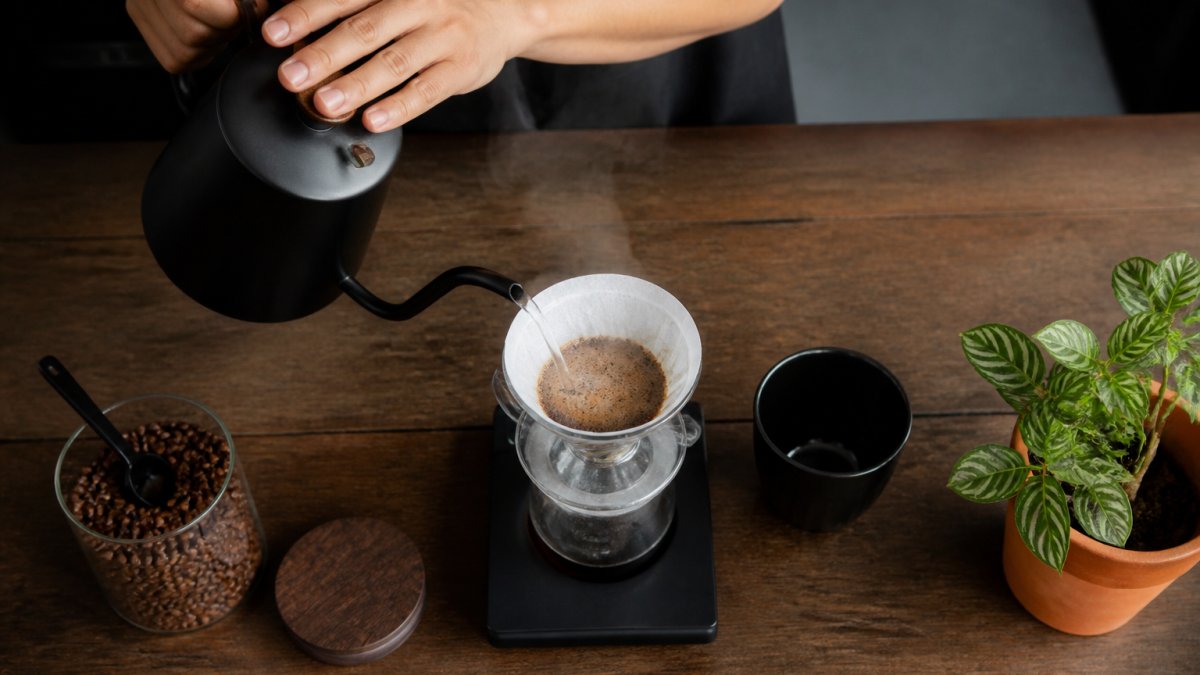
A worked example. Start with 20 g of medium-fine coffee and 300 g of water at roughly 200°F, a 1:15 ratio. That gives you 120 g for the first phase (40%) and 180 g for the second (60%).
- Rinse the filter, add the grounds, and tare the scale with the dripper on it.
- Pour 60 g of water to bloom the bed, then wait about 45 seconds.
- Pour the remaining 60 g of the first phase in a slow spiral, finishing around 1:15.
- For the second phase, pour the 180 g in two or three equal additions, for example 60 g at a time, pausing until the bed drains to just above the grounds between pours.
- Aim to finish the final pour around 3:00 to 3:30, with the bed draining by roughly 3:30 to 4:00.
The method's appeal is repeatability. Because every pour is measured, you can change one variable at a time and actually learn from the result. If the cup tastes sour, tighten the second-phase pours or grind slightly finer; if it tastes bitter or hollow, loosen the pours or coarsen the grind.
Watch out: the 4:6 method only works if your grinder produces a consistent medium-fine bed, a blade grinder's fines will stall the drawdown and push the cup bitter no matter how carefully you pour.
Grind Size, Ratio, and Water Temperature: The Variables That Matter
Three variables decide most of what's in your cup: grind size, coffee-to-water ratio, and water temperature. Get these consistent and your coffee improves immediately, regardless of method.
Grind size controls how fast water extracts flavor. Coarse grind suits French press and cold brew, medium grind fits drip and pour-over, and fine grind works for AeroPress and Moka pot. Grind consistency matters as much as the setting: a burr grinder produces uniform particles, while a blade grinder leaves fines that over-extract and boulders that under-extract. If you are choosing a grinder, a conical or flat burr grinder is the single upgrade that makes every other variable controllable; a blade grinder can work in a pinch but will never give you a repeatable setting.
Calibrating your grinder. Most burr grinders have a numbered dial, but the numbers are not comparable across brands. Dial in by method: start at the manufacturer's midpoint for drip, then adjust one click at a time and taste. If the cup is sour, go finer; if bitter, go coarser. Write down the setting that worked so you can return to it.
Ratio. Start around 1:15 to 1:17 coffee-to-water by weight and adjust to taste. Concrete starting points: 20 g coffee to 300 g water for pour-over, 30 g to 500 g for French press, and 15 g to 250 g for AeroPress. A digital scale readable to 0.1 g is the tool that makes these numbers real.
Temperature. Target roughly 195-205°F. Lighter roasts generally reward the hotter end of that range, darker roasts the cooler end, because darker beans extract more readily and can turn bitter at high heat.
Watch out: changing grind, ratio, and temperature at the same time makes it impossible to know which change fixed or broke the cup, adjust one variable per brew.
A digital scale and a decent burr grinder are the two purchases that pay off fastest.
How Water Quality and Mineral Composition Change Flavor
Water is over 98% of your cup, so its quality changes flavor more than most brewers realize. Filtered water removes chlorine and off-notes that mask aroma, while the right mineral content helps extraction. Water that's too soft can leave coffee tasting flat; water that's too hard can mute brightness and clog your equipment over time.
The practical move is simple: use filtered water, and if your tap is very hard or very soft, try bottled or a mineral-adjusted water to see the difference. A single-origin Colombia bean lets you taste how water and origin affect flavor clarity.
Troubleshooting by Taste: Fix Sour, Bitter, or Weak Coffee
Your palate is the best diagnostic tool you have. Sourness usually means under-extraction: the grind is too coarse, the water too cool, or the brew time too short. Bitterness points to over-extraction: too fine a grind, water too hot, or steeping too long. Weak coffee often comes down to too little coffee for the water, or an uneven grind.
Start by changing one variable at a time. If a cup tastes sour, grind finer or extend the brew time slightly. An Ethiopia Natural with its fruity, bright profile helps you calibrate sour versus sweet taste notes. If it's bitter, coarsen the grind or drop the temperature a few degrees.
Cleaning and Equipment Maintenance for Consistent Results
Dirty equipment is one of the most overlooked causes of bad coffee. Oils from coffee grounds go rancid and leave a bitter, stale taste that no fresh bean can fix. Rinse your French press and AeroPress after every use, and give your pour-over dripper and carafe a proper wash regularly.
For drip machines and Moka pots, descale on a schedule based on your water hardness. Mineral buildup changes how the machine heats and flows water, which quietly shifts your extraction. A clean grinder matters too: brush out the burrs periodically so old grounds don't contaminate fresh ones. Consistency starts with clean tools.
Choosing Beans and Building a Repeatable Morning Recipe
The final step is turning everything above into a routine you can repeat without thinking. Choose whole beans from a roaster who tells you the roast date, buy in amounts you'll finish while the coffee is still fresh, and store them in an airtight container away from light and heat. Freshness is the foundation every other technique rests on.
Then lock in your recipe. Write down your dose, water weight, grind setting, temperature, and brew time. Change one thing at a time and note the result. That written record is what separates brewers who improve from those who guess.
Brewing better coffee at home is less about gear and more about freshness, measurement, and repetition. At Modern Mariachi Coffee, we offer carefully sourced beans roasted to order. Explore our roasted-to-order blends, ceremonial grade matcha, and mushroom-infused teas, and turn your morning ritual into something you actually look forward to. Get started with Modern Mariachi Coffee and taste the difference freshness makes in your very first cup.
Frequently Asked Questions
What is the best method to brew coffee at home?
There is no single best method, but pour-over gives the most control over grind size, water temperature, and brew time, which makes it easiest to brew better coffee consistently. French press suits anyone who prefers a fuller body and a forgiving process. A drip machine wins on convenience for busy mornings. Start with the method that matches your routine, then adjust one variable at a time until the cup tastes right to you.
What is the 4:6 method for brewing coffee?
The 4:6 method splits your total water into two parts. The first 40 percent sets the strength of the cup through a bloom and one pour. The remaining 60 percent, poured in two or three stages, controls flavor and acidity. A coarser grind and fewer pours produce a sweeter cup; a finer grind and more pours push toward brighter acidity. Use a scale and timer so each brew is repeatable.
How do grind size and freshness affect coffee flavor?
Grind size controls how fast water extracts flavor. Too fine and the cup turns bitter; too coarse and it tastes sour or thin. Freshness matters just as much. Whole beans generally hold their aroma longer than ground coffee. Buy freshly roasted whole beans, grind right before brewing, and store them in an airtight container away from light and heat.
How do I make good coffee at home without a machine?
You only need a kettle, a filter, and a dripper or press. A pour-over cone with paper filters costs little and delivers a clean cup. A French press needs no electricity at all: add coarse grounds and hot water, steep for four minutes, then press. Both methods reward a consistent coffee-to-water ratio, so weigh your grounds and water rather than scooping by eye.
What is the best way to make coffee for one person?
A single-cup pour-over or an AeroPress is ideal for one person. Both brew in under four minutes and let you measure a small dose accurately, usually 15 to 18 grams of coffee to 250 grams of water. A small French press also works well. Avoid brewing a full pot if you will only drink one mug, since coffee held on a hot plate turns bitter quickly.
How can I make my coffee taste better at home?
Change one variable at a time. Start with freshly roasted whole beans and filtered water, then check your ratio, typically 1 gram of coffee to 15 to 17 grams of water. Adjust grind size next: finer if the cup tastes weak or sour, coarser if it tastes bitter or dry. Keep a timer and scale handy, and clean your equipment weekly so old oils do not spoil the flavor.
